Volatile Markets
Written and accurate as at: Mar 02, 2022 Current Stats & Facts
Hello Everyone,
I was thinking that it has been quite a start to 2022.
January, saw markets became volatile due to high inflation figures in US and now in February there are uncertainties on how long the crisis in Ukraine will last.
From the initial drop last week the markets have recovered, and analysts are saying that maybe the selling was overdone. Although severe sanctions have been imposed on Russia in response to the attack, the measures are not seen as crippling as some had feared.
The West's seeming unwillingness to target Russia's energy sector has helped ease worries about a spike in oil and gas prices fuelling further inflation. After reaching a high above $100 a barrel in the previous session, crude for April delivery tumbled to $91.59 a barrel.
News that Russia is prepared to send a delegation to Belarusian capital Minsk for talks about Ukraine also contributed to the positive sentiment.
But when volatility hits, what can be done?
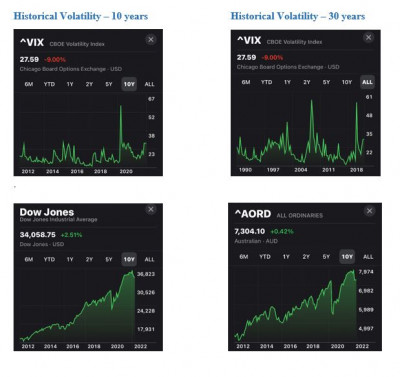
Volatility is inevitability due to the inherent uncertainty in both the world and the financial
marketplace. It is also important to look at the what has occurred in recent history. Severe volatility was experienced at the start of the pandemic in 2000 and the other big one in 2008, but it has always been there.
Despite the ever-present volatility, markets have been positive consistently since GCF.
According to Bank of America, if an investor missed the S&P 500’s 10 best days in each decade, total returns would be 91%, compared to the 14,962% return for investors who “held steady through the downturns”
Furthermore, each time a 60/40 portfolio (60% - Growth and 40% - Defensive) has taken at least a 20% hit - which has occurred four times in the past 75 years – in the first three instances, the portfolio returned to peak levels within 10-20 months and the recovery time from the falls observed in February/March 2020 pandemic outbreak were significantly less.
Our views on the BWM model portfolios at present are:
- Retain long-term views and ensure that portfolio asset allocations match clients’ risk tolerance. “Conservative” or “Growth.
- Not make decisions based on market predictions from strategies and keep in mind long-term objectives.
- Keep high levels of diversification in portfolios as it will have greater resilience to volatility.
- Continue to hold quality investments and companies which is again vital in building resilience in portfolios.
- Evaluate that during periods of volatility, the impact of current events on individual companies are different. For instance, sectors such as technology or retail or bio-tech will have dramatically different experiences during volatility. The challenges or opportunities which companies face may look very different before volatility began.
- Consider capital injections into the market in “predetermined intervals” to moderate exposure to ongoing volatility.
I hope this provides peace of mind and assurances, despite global events being outside anyone’s control.
Please contact us if you wish to discuss concerns so that we can make appropriate adjustments to meet objectives.
Stay Safe.
Akash Brahma